· Ivan K.
Meridian: keeping up with the agents
I got fatigued from keeping track of coding agents working in parallel. Claude would be doing something in one terminal, Codex in another, with several projects in flight. I kept switching between them to see who had finished, who was stuck, and who had asked me a question.
So I made yet another agent orchestration super-harness. It's called Meridian, and it's a native Mac app.
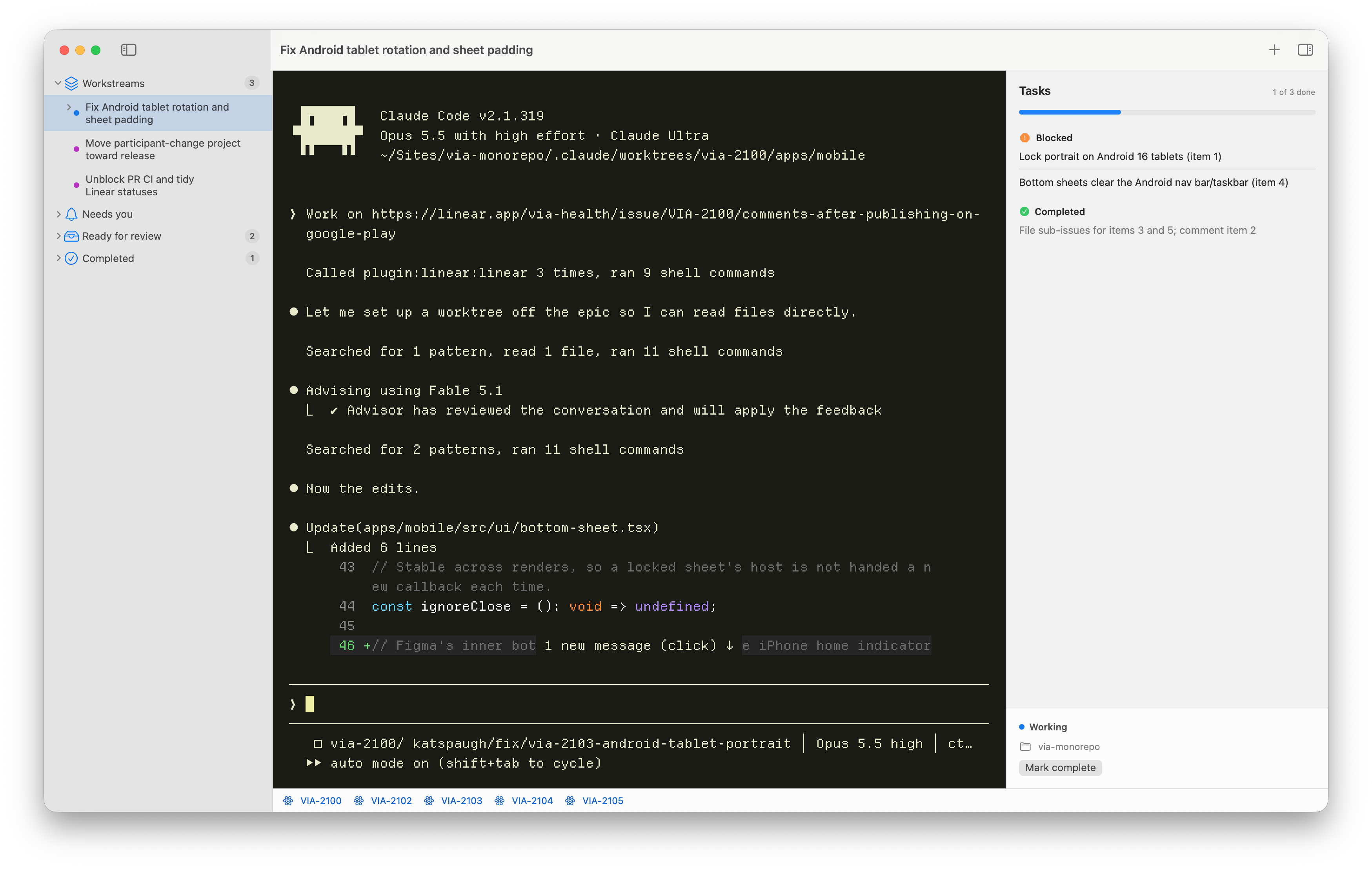
The part I wanted help with was supervising all that work. An agent can do a substantial task on its own, then stop over a small decision. With several agents running, checking on them and getting them moving again becomes a job of its own.
A task list they share
Meridian groups work into workstreams. Each has terminals, a working directory, and a built-in task tracker based on Beads. The agents maintain the tasks as they work: planned steps, progress, dependencies, and blockers. I can see them beside the terminal or across workstreams on a sprint board.
Claude and Codex can work in parallel on the same workstream. They share its worktree and Beads tasks, so context about the work can survive beyond either agent's conversation. One can pick up a task with the other agent's progress and blockers already recorded. That shared record matters when I'm switching agents or asking one to review the other's work.
The soul of the app
Meridian also has an AI process supervising the agents. I think of it as the soul of the app: it keeps an eye on the work and acts as an intermediary between me and the agents.
When an agent stops, Meridian can look at the situation and give it direction. It can make a reversible decision, point it towards missing information, or send it to another task if the current one is blocked. It can read the project and inspect task state to work out what to suggest. The coding agents carry out the work.
This is also where some judgment is needed. An agent waiting for a background command doesn't need a motivational speech. A finished task should stay finished. If I've just asked an agent a question, Meridian should let us talk. And sending the same instruction again when it has already failed doesn't help.
Needs your attention
“Needs you” is a prominent part of the interface. Permission requests, questions, errors, and blocked tasks surface there. A blocked task should say why it's blocked and what needs to happen to unblock it. Finished work has a separate “Ready for review” section.
That's the view I wanted when I started: somewhere I can see what actually needs my attention without opening every terminal to find out.
The terminals are persistent, much like tmux sessions. They're built with Ghostty, with dtach keeping the processes alive when I quit the app. Reopening Meridian reconnects to the running sessions. After a reboot, agents can resume from their saved conversations; terminal scrollback doesn't survive an app restart.
I still go into the terminals to work directly with Claude or Codex. Meridian gives those conversations a shared task record and someone to check on them while I'm elsewhere.